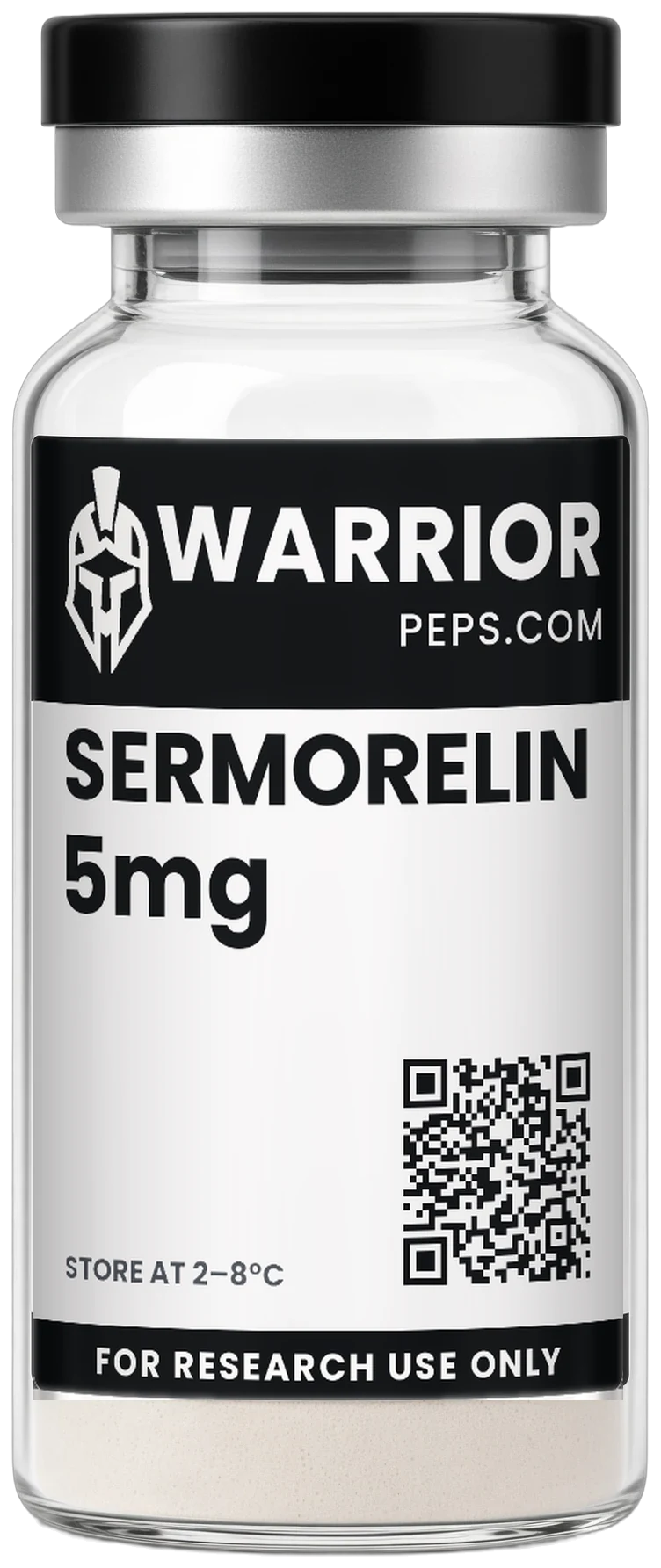
Sermorelin 5MG
The first 29 amino acids of GHRH — the shortest fragment that keeps the parent molecule's activity.
Leave your email and we'll let you know the moment it's back.
What Sermorelin is, in plain English.
Sermorelin is a synthetic peptide made up of the first 29 amino acids of growth-hormone-releasing hormone (GHRH), the 44-amino-acid hormone the hypothalamus uses to signal the pituitary gland. Its molecular formula is C149H246N44O42S, with a molecular weight of about 3,357.9 g/mol and the CAS number 86168-78-7, and it is also written GRF (1-29). Those 29 residues are the shortest fragment found to keep the parent molecule's activity at the GHRH receptor, which is why the fragment rather than the full hormone became the standard research tool from the 1980s onward. Like the natural hormone it is short-lived, with a half-life reported at under ten minutes, and the growth hormone it releases stays under the body's own feedback control, the property GHRH-based compounds are studied for. It is commonly researched in growth-hormone-axis models, and it sits alongside Tesamorelin (a stabilised full-length GHRH analogue) and Ipamorelin (which works through the ghrelin receptor instead) in that section of the range. It has a clinical history: it was approved in the United States in 1997 for children with growth-hormone deficiency and was also used as a diagnostic agent for growth-hormone secretion, but its manufacturer stopped making it in 2008 for commercial reasons and it is no longer available there as an approved medicine. The World Anti-Doping Agency lists it by name among the prohibited GHRH analogues. Supplied as 5mg of freeze-dried powder per vial, for reconstitution with bacteriostatic water; store at 2–8°C.