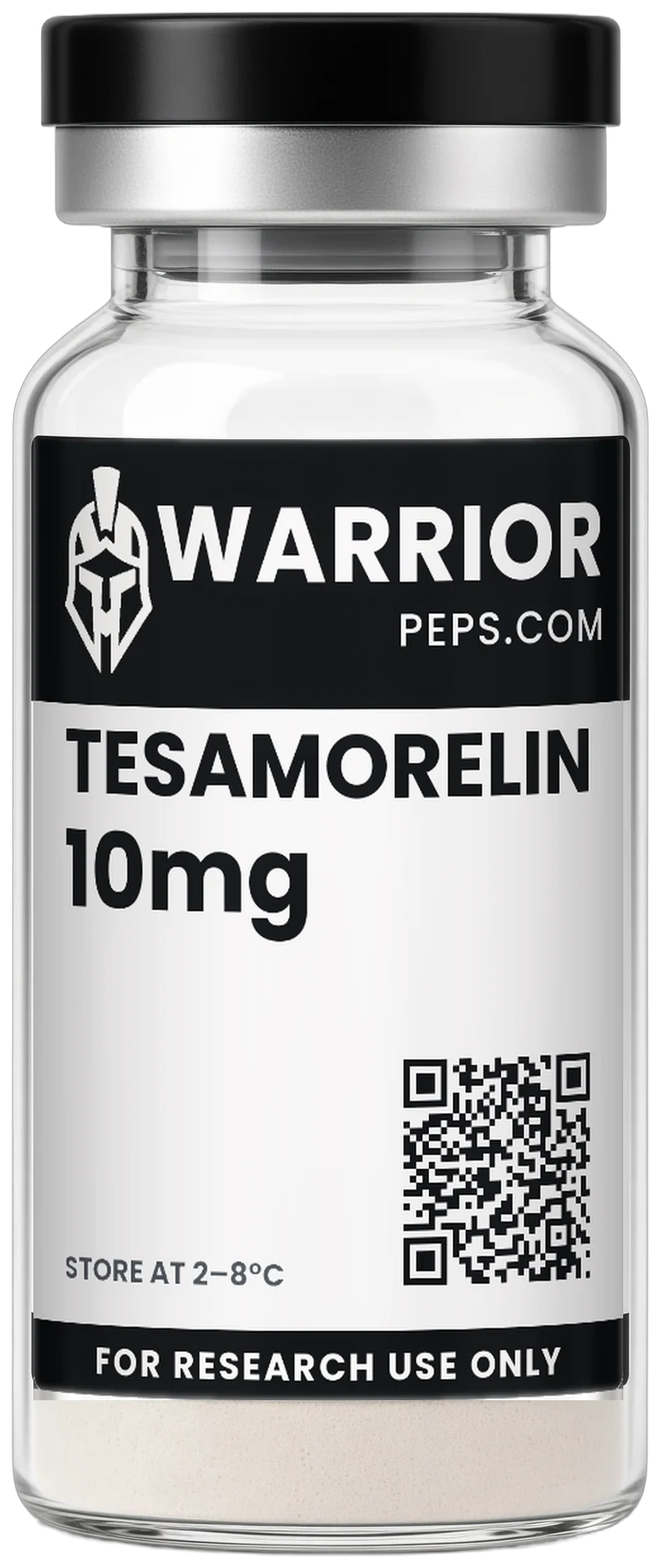
Tesamorelin 10MG
A stabilised GHRH analogue, 44 amino acids long. 10mg of freeze-dried powder.
What Tesamorelin is, in plain English.
Tesamorelin is a synthetic analogue of growth-hormone-releasing hormone (GHRH), the 44-amino-acid hormone the hypothalamus uses to signal the pituitary gland. It contains all 44 amino acids of the human hormone with a trans-3-hexenoic acid group attached at the N-terminus, and has the molecular formula C221H366N72O67S, a molecular weight of about 5,136 g/mol and the CAS number 218949-48-5. The added group protects the molecule from the enzyme that clears natural GHRH within minutes, and that single change gives it a working half-life the native hormone never had. Because it acts at the pituitary's own GHRH receptor, the growth hormone it releases still follows the body's pulsed rhythm and feedback controls, which is the property GHRH analogues are studied for. It is the most extensively published GHRH analogue in the literature, commonly researched in growth-hormone-axis and body-composition models, abdominal fat in particular. It is one of the few compounds in the range whose molecule is a licensed medicine: it was first approved in 2010, for HIV-associated lipodystrophy, a disorder of fat distribution. What is supplied here is not that medicine and is not a licensed product. The World Anti-Doping Agency lists it by name among the prohibited GHRH analogues. It is the full-length counterpart to Sermorelin's 29-residue fragment in that section of the range. Supplied as 10mg of freeze-dried powder per vial, the only fill we stock, for reconstitution with bacteriostatic water; store at 2–8°C.