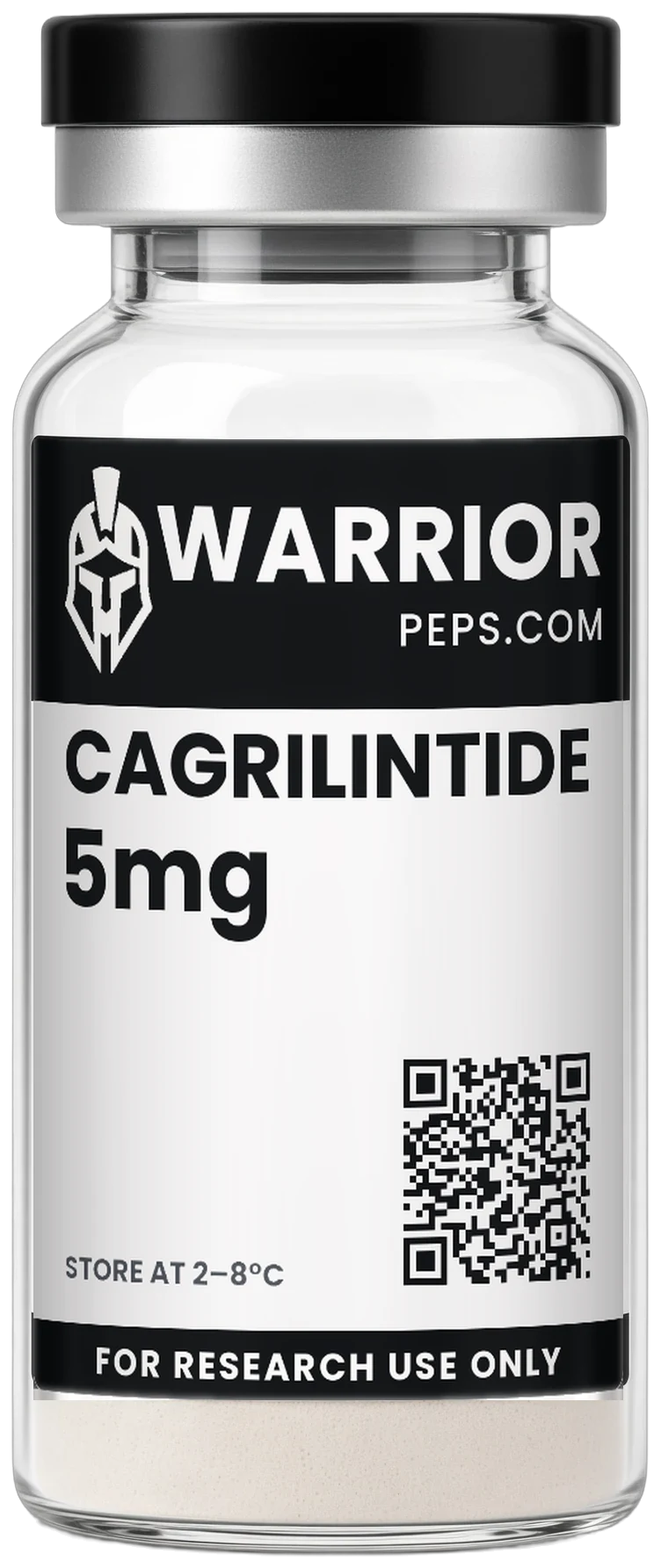
Cagrilintide 5MG
A long-acting amylin analogue — the newest addition to the metabolic line. 5mg per vial.
What Cagrilintide is, in plain English.
Cagrilintide is a synthetic, long-acting analogue of amylin, the 37-amino-acid hormone the pancreas releases alongside insulin after a meal. Its molecular formula is C194H312N54O59S2, with a molecular weight of about 4,409 g/mol and the CAS number 1415456-99-3. Natural amylin signals fullness and slows the emptying of the stomach, but it tends to clump into amyloid fibrils, which makes it a difficult molecule to work with. Cagrilintide is built around that problem: it is a stable analogue with a fatty-acid chain attached (lipidation), which gives it a half-life long enough to sit in the extended-release generation of metabolic peptides. It is commonly researched on its own and, in the published literature, in combination with GLP-1 analogues, which is where most of the current interest sits: amylin and GLP-1 act through different receptors, and the question under study is how the two signals add up. Unlike most compounds in the range it has been studied in large human trials, both alone and in that pairing, including a 68-week trial of the compound on its own. What is supplied here is not a licensed medicine. Supplied as 5mg of freeze-dried powder per vial, for reconstitution with bacteriostatic water; store at 2–8°C.