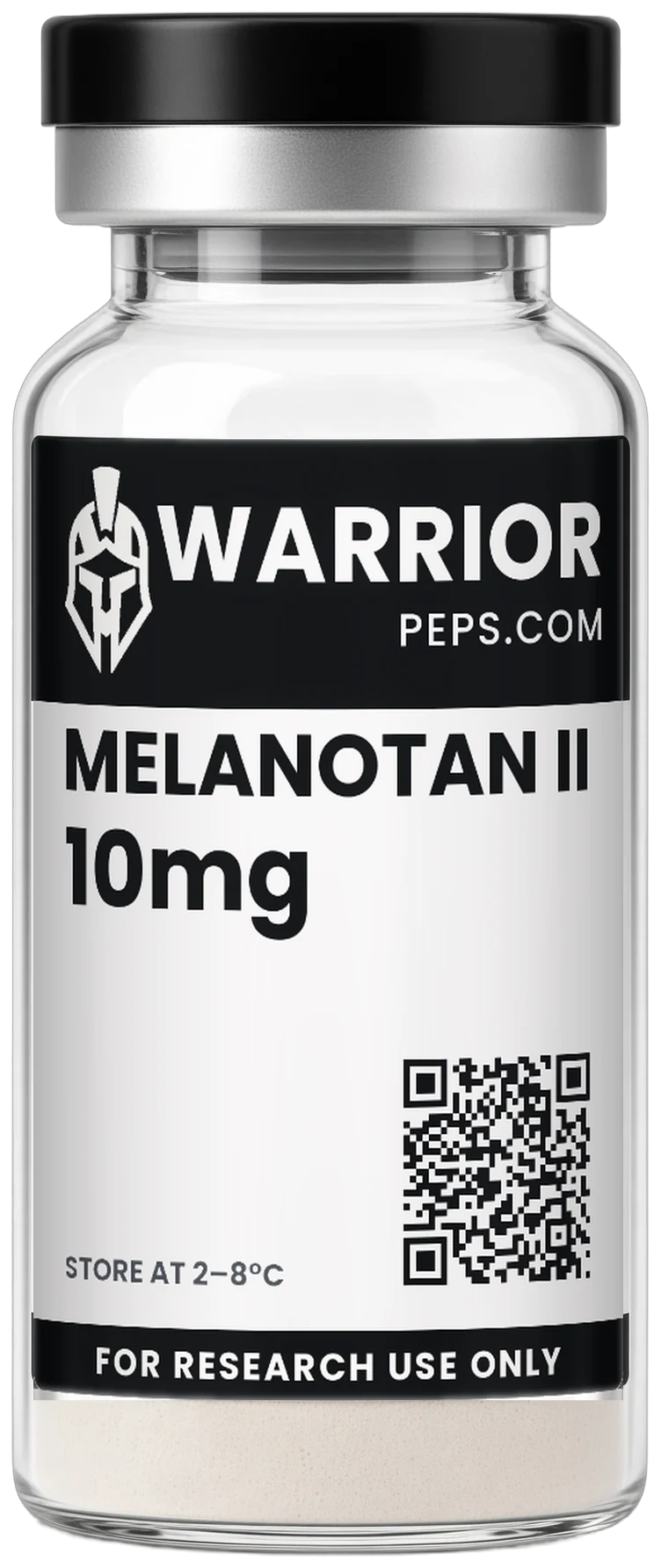
Melanotan 2 10MG
A cyclic analogue of alpha-MSH, studied in pigmentation research. 10mg per vial.
What Melanotan 2 is, in plain English.
Melanotan II is a synthetic cyclic heptapeptide modelled on alpha-melanocyte-stimulating hormone (α-MSH), the hormone that signals pigment cells. It has the molecular formula C50H69N15O9, a molecular weight of about 1,024.2 g/mol and the CAS number 121062-08-6. Its seven amino acids are a shortened, modified version of the natural hormone's core, and a chemical bridge between two of them closes the chain into a ring, which is what makes it more stable and longer-acting than the hormone it copies. It was developed at the University of Arizona in the 1980s, in the same programme as Melanotan I, by researchers looking for α-MSH analogues as sunless tanning agents. It is a non-selective agonist of the melanocortin receptors: it acts at MC1, MC3, MC4 and MC5 rather than at a single receptor. It is commonly researched for its role in melanin production and pigmentation, the MC1 pathway in particular, and, because the same receptor family runs through other systems, in appetite and sexual-function models. Its development as a medicine was abandoned in 2000 in favour of a closely related compound, and it has never been approved anywhere. Medicines regulators in several countries, the UK's MHRA among them, have issued warnings since 2007 against its use in people, and the effects reported in the literature include nausea, facial flushing and the darkening of moles and freckles. Supplied as 10mg of freeze-dried powder per vial, for reconstitution with bacteriostatic water; store at 2–8°C.